
An editorial selection from our September 2026 white paper, following the journey from early design decisions to connected data, environmental modeling, and practical trade-offs.
Approximately 30% of the original paper, adapted for the web.01 / Decision-making insight
Better decisions begin before production.
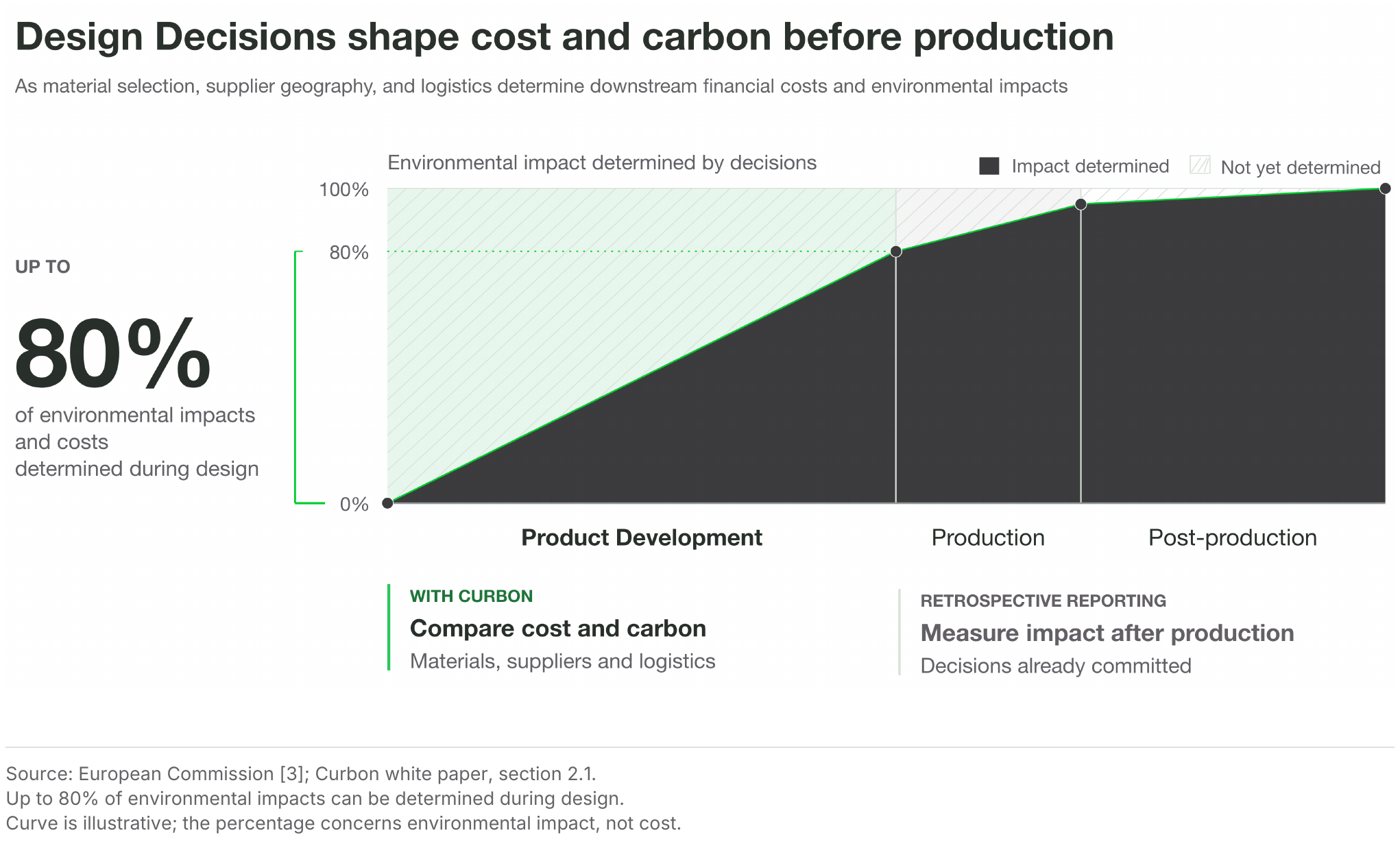
A product’s cost and environmental footprint are determined long before production by key decisions about material selection, supplier geography, and supply-chain logistics. However, the teams making those decisions lack a connected view of their consequences. Product, costing, and quality systems hold useful information, but combining it requires substantial coordination. Environmental analysis is often separated from product development and conducted for subsequent reporting.
The European Commission estimates that up to 80% of a product’s environmental impacts can be determined during design. Material composition, supplier geography, quality requirements, and logistics are interconnected. Environmental insight belongs alongside the commercial judgment that shapes these decisions.
Sustainability reporting asks what happened, while product development requires an understanding of what could happen next. Approved-material lists provide direction, but do not by themselves quantify the consequences of combining a material, manufacturing location, and transport plan. Curbon aims to bring evidence-backed comparisons into development before product choices become supply-chain commitments.
The primary users are product-development, raw-materials, sourcing, technical-development, and production teams. Their goal is to translate designs into manufacturable, commercially viable products. Curbon’s aim is to make environmental science useful in these everyday decisions without requiring users to become environmental scientists.
02 / Industry context
The gap between climate goals and everyday choices.
Curbon’s thesis is that industry-wide climate progress must begin with more intelligent day-to-day decisions in product development, where material, supplier, production, and logistics choices can help reduce Scope 3 emissions.
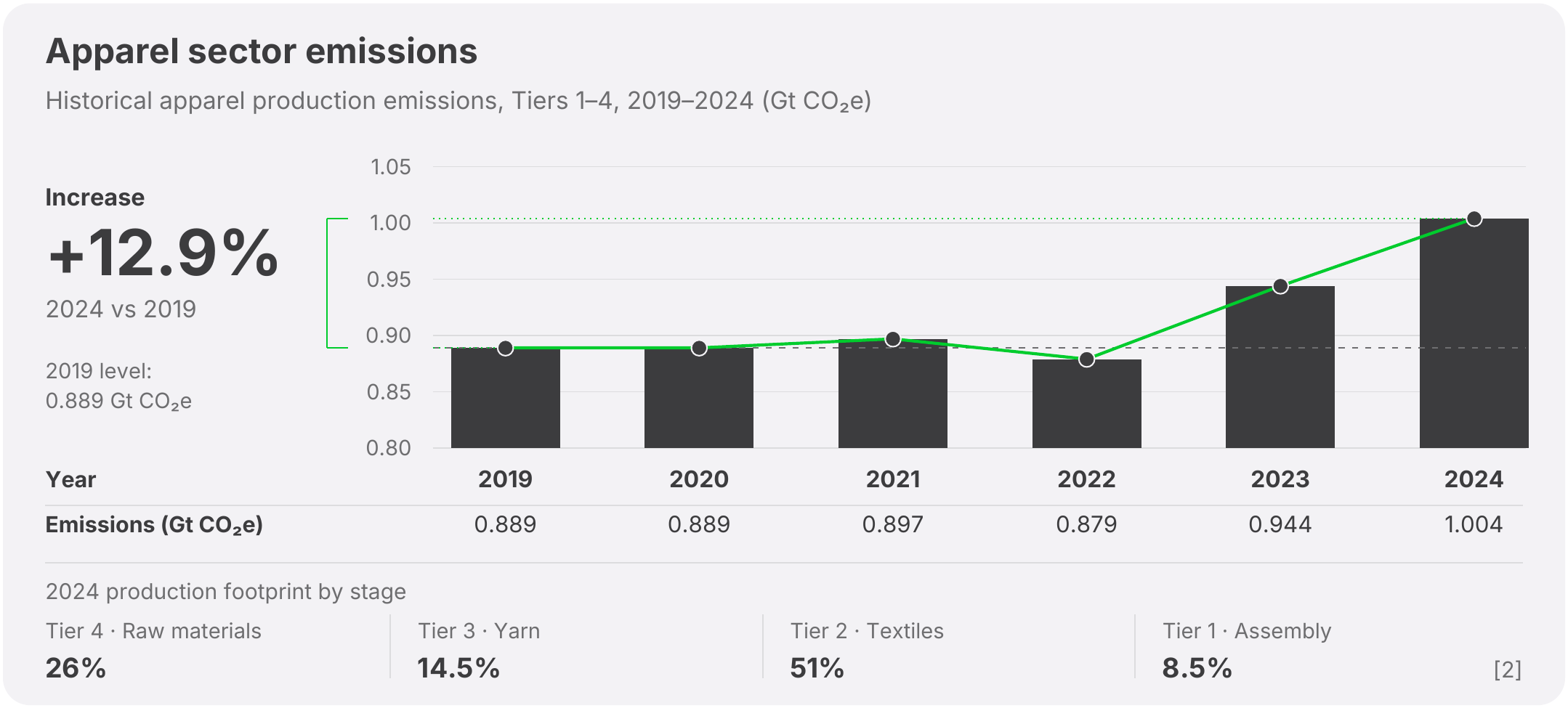
The Apparel Impact Institute estimates that apparel production emissions rose 6.3% in 2024. Its modeled production footprint reached 1.004 gigatonnes of CO₂e, compared with 0.889 gigatonnes in 2019. Textile production accounted for 51% of the modeled 2024 footprint, raw materials for 26%, yarn for 14.5%, and assembly for 8.5%.
These estimates cover apparel production across Tiers 1–4. They exclude Tier 0, use, end of life, downstream transport, and many trims. Decision-making tools cannot replace clean energy or production cuts, but they can help brands identify impactful, cost-effective changes.
03 / Learning from Nike Considered
Make environmental insight part of the workflow.
Nike’s Considered Index, introduced in 2007, linked a product’s bill of materials to environmental scoring through an intranet calculator. Teams could score products in roughly a minute, use the tool at development checkpoints, and receive training and specialist support. Building the Index took six tools-team members 18 months. Data gaps required simplified proxies, while teams still had to meet margin, performance, and production requirements.
Nike’s Materials Sustainability Index was adopted by the Sustainable Apparel Coalition in 2012 and supported the MAKING design app launched in 2013. Curbon aims to build the next generation of this approach: connecting operational data to environmental modeling and mathematical optimization to explain what to change, why, and within which commercial limits.
The approach combines AI to interpret scattered information and user intent, documented inventories to support calculations, and mathematical solvers to evaluate feasible alternatives. The aim is to move from scoring a design toward understanding the changes available to a product team.
A recommendation that cannot be produced, delivered, or afforded is not useful. Curbon treats cost, lead time, approved suppliers, and material specifications as part of the analysis, making trade-offs explicit wherever cost and carbon objectives conflict.
04 / Fragmented product data
Connect the full product story.
Product specifications and bills of materials may sit in product lifecycle management systems; purchasing and cost records in enterprise resource planning and supply-chain management platforms; budgets and margin targets in enterprise performance management tools; and logistics and quality data in dedicated internal systems. Spreadsheets, email, Slack, and Teams hold additional details and context.
Curbon’s starting point is to connect those records without replacing existing systems: linking a material price to its specification, supplier, quantity, season, and terms, and connecting transport assumptions to the development calendar. These relationships establish the foundation for understanding operations and evaluating alternatives.
Environmental reference data and operational records answer different questions, but both are necessary for environmental modeling. A database can support better analysis only if it is connected to knowledge of the supply chain. Deployment requires agreed permissions, field mappings, refresh schedules, and data-handling rules. Missing or conflicting information must remain visible.
Corporate sustainability goals also require translation. Curbon connects product and collection scenarios to relevant targets, baseline years, volumes, and time horizons. A corporate target does not automatically create a carbon budget for every garment: that requires explicit allocation assumptions and compatible accounting boundaries.
05 / The digital twin
An evidence-backed model of the supply chain.
Curbon’s digital twin is a structured representation of a product and its supply chain. It connects materials, quantities, suppliers, processes, locations, and commercial records so dependencies can be examined together. In the prototype, these relationships can be traced to supporting attachments and passages.
The digital twin’s purpose is to connect information and establish the evidence and context needed to model and improve product configurations with reduced environmental impacts. Its coverage depends on the available records, and its assumptions are explicitly identified. Missing information becomes a question to resolve or an explicit scenario assumption, not an invisible fact supplied by the system.
This shared analytical foundation can support different views and responsibilities. Product teams need to compare specifications, costs, and timing. Sustainability teams contribute reviewed data, material classifications, methodological judgment, and targets, while merchandising, finance, and leadership contribute planning priorities.
06 / The role of AI
Familiar language. Dedicated analytical tools.
The large language model interprets documents and user requests, retrieves context, and invokes analytical tools. Curbon’s cost calculations, life-cycle assessment routines, and optimization models perform the mathematical work, allowing users to describe objectives in familiar language rather than through database queries or equations.
The intended workflow presents objectives, constraints, and important assumptions for confirmation, links results to their inputs, and surfaces critical gaps before proceeding. Deterministic calculations make an analysis reproducible for the same inputs and configuration; extraction, assumptions, and models still require validation. AI makes the tools accessible without replacing the evidence on which they depend.
The architecture connects a user’s question to business records and environmental reference data. The agent coordinates the LCA engine and mathematical optimizer, then presents options with their costs, emissions, and assumptions so that teams can assess the answer.
07 / Brand-specific cost modeling
Model the costs a brand actually pays.
Costs depend on product specifications, material consumption, order quantities, supplier relationships, and negotiated terms. A price recorded in a bill of materials may differ from the final price for a particular season or order. Curbon’s intended inputs include itemized supplier quotes, purchase orders and invoices, material and manufacturing charges, and relevant freight and import costs.
Reference prices, current quotes, historical charges, and estimates must remain distinguishable. The model must define whether it compares free on board or landed costs, recognize charges already included in bundled quotations, and align quantities, units, currencies, and validity dates. Where sufficient detail exists, material consumption and prices can be combined with manufacturing and logistics costs. Otherwise, historical records can inform explicitly labeled estimates, which are not supplier commitments.
Changes in composition or dimensions affect material consumption and cost. Connecting results to agreed selling-price and cost definitions supports margin analysis. The comparison therefore needs to reflect the brand’s actual commercial context and the validity of each underlying record.
08 / Environmental modeling
Recalculate impact as the product changes.
Curbon’s real-time life-cycle assessment engine translates product and supply-chain activities into carbon-footprint calculations. The current focus is greenhouse-gas emissions, expressed in kilograms of carbon dioxide equivalent, rather than every dimension of sustainability. Each assessment needs a defined product unit and boundary, with excluded stages identified.
Calculations link materials, processes, energy, and transport to suitable inventories or emission factors, then aggregate climate impacts within that boundary. Supplier evidence can inform the model; documented background inventories support areas without direct information. Dataset selection must consider geography, technology, time period, and boundaries. Reviewed data do not automatically represent a particular supplier.
The goal is interactive recalculation as product or sourcing scenarios change. Missing operational evidence, approved proxies, estimates, and uncertainty remain explicit. When essential data are missing, Curbon is designed to flag the gaps and ask users for additional information or supporting records.
A truck’s emission factor cannot establish that an undocumented shipment traveled by truck. Missing operational evidence and missing reference data are different problems. Keeping that distinction visible reduces the risk of treating an assumption as a known feature of the supply chain.
09 / Mathematical optimization
Explore feasible alternatives, together.
A cheaper material may require more expensive freight.Optimize the configuration, not a single input.
With a baseline, evidence, and operating requirements established, the system evaluates combinations that are difficult to compare manually. A request can define an order quantity, ask for lower unit cost and carbon emissions, and require the same material specifications and delivery date. The workflow translates this into decision variables, objectives, and constraints.
Depending on scope and evidence, the model can vary approved materials, suppliers, processes, production allocations, and transport choices while holding essential requirements fixed. It searches configurations: a cheaper material, for example, may require more expensive freight.
Where cost and emissions reductions align, those options should appear first. Where they conflict, a Pareto set presents feasible alternatives for which improving one objective requires worsening another within the evaluated solution set. Users compare changes, costs, emissions, assumptions, and constraints. An infeasible request should produce an explanation; optimality claims remain tied to the model, available choices, and solver result.
Curbon’s goal is to augment human decision-making by reducing the administrative time spent finding and reconciling information across record-keeping systems. Teams can then devote more attention to evaluating cost, carbon, quality, and lead-time trade-offs across materials, suppliers, and logistics.
10 / From insight to adoption
Keep commercial reality in the model.
Critical operating knowledge often lives outside formal specifications. Inspection results may reveal issues with a material or construction method; experienced colleagues may know a supplier’s delivery history. Curbon is designed to let users configure company- and team-specific requirements, priorities, and flags so that past experience can inform future decisions.
Mandatory requirements would constrain feasible configurations, while historical concerns would trigger evidence-backed warnings for review. Alongside cost limits, margin objectives, and environmental targets, this context would help teams pursue cost-and-carbon improvements within their operating requirements.
Curbon is seeking design partners to develop the current product into a dependable enterprise system. The proposed evaluation starts with data coverage and reduced retrieval effort, then validates cost-and-carbon calculations against reference cases. Broader deployment would follow demonstrated value, with product-development, sustainability, and technology teams helping define the evidence and workflows that matter.
A focused initial use case would establish the data foundation and test outputs with intended users. Longer-term collaboration would extend validated capabilities across additional products, categories, and supply-chain decisions, guided by the partner’s operational needs and readiness to adopt them.
Continue the research
The complete picture.
Selected and adapted from Curbon, Integrating Sustainability into Product Development, September 28, 2026. Page references correspond to the supplied PDF. External findings remain attributed to the original sources.
Contact for full white paper